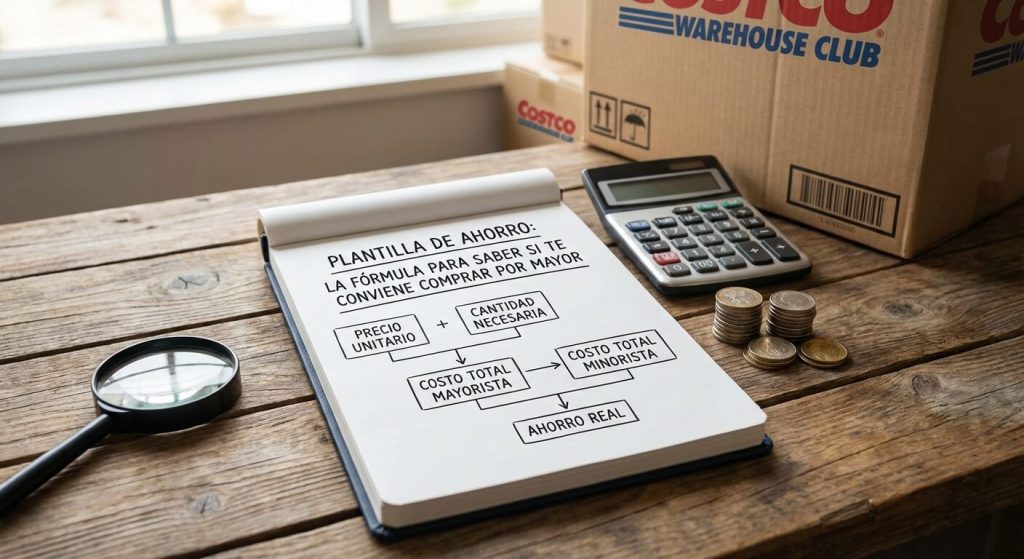
Savings Template: The Formula to Determine Whether Buying in Bulk is Right for You
Have you ever bought a giant package of something “because it was convenient” and ended up letting it expire in your pantry? Or worse: did you avoid buying in bulk thinking it wasn’t worth it, when in reality you could have saved thousands of pesos? For these types of situations, a savings template can help […]
Have you ever bought a giant package of something “because it was convenient” and ended up letting it expire in your pantry? Or worse: did you avoid buying in bulk thinking it wasn’t worth it, when in reality you could have saved thousands of pesos? For these types of situations, a savings template can help you better organize your purchases.
The problem isn’t buying in bulk. The problem is not knowing when it’s a good idea and when it’s not.
In this article, I’ll give you the savings template I use to make that decision in seconds. It includes a simple mathematical formula (don’t worry, it’s easy) and a table for saving money with 100 products and the actual savings percentage for each one.
The savings template that nobody taught you about
Before showing you which products are best to buy in bulk, you need a tool to help you decide for yourself. Because what is right for a family of five is not right for someone who lives alone.
This formula considers two things that no one takes into account:
- The money you save per unit
- The time you save on trips to the supermarket
The variables
| Variable | What does it mean? | Example |
|---|---|---|
| P_retailer | Price per unit when buying small | $200/roll |
| P_wholesaler | Price per unit when buying in bulk | $150/roll |
| C | How much do you consume per month? | 8 rolls |
| L | Product shelf life (months) | 12 months |
| N | Units in the large pack | 24 rolls |
| T | Time it takes you to go shopping (hours) | 1 hour |
| V | How much is your time worth? | $2,000/hour |
The formula
Step 1: Calculate how many units you will actually use:
Unidades utilizables = mínimo entre (N) y (C × L)
Step 2: Calculate the convenience index:
Índice = (Unidades × P_minorista + Viajes_minorista × T × V) ÷ (N × P_mayorista + Viajes_mayorista × T × V)
How to interpret the result
| Index | What does it mean? |
|---|---|
| Less than 1 | It is NOT advisable to buy in bulk. |
| Equal to 1 | It doesn’t matter |
| Greater than 1.1 | It is advisable to buy in bulk. |
| Greater than 1.2 | It’s VERY worthwhile, you’re really saving money. |
Practical example: toilet paper
- Small pack: 4 rolls × $800 = $200/roll
- Large pack: 24 rolls × $3,600 = $150/roll
- Household consumption: 8 rolls/month
- Travel time: 1 hour
- Value of your time: $2,000
Calculation:
- Retail cost: (24 × $200) + (6 trips × 1 hour × $2,000) = $4,800 + $12,000 = $16,800
- Wholesale cost: (24 × $150) + (1 trip × 1 hour × $2,000) = $3,600 + $2,000 = $5,600
- Index: 16,800 ÷ 5,600 = 3.0
The result? By purchasing the large pack, you save three times what you would spend buying smaller quantities. That’s money and time in your pocket.
Money-saving chart: 100 products that give you the most bang for your buck
Now that you have the formula, here is a list of products where buying in bulk makes the most sense. I have sorted them by category and included the estimated savings for each one.
Food and Beverages
| Product | Estimated savings | Frequency of use |
|---|---|---|
| Rice | 15-20% | Daily |
| Dry pasta (noodles) | Up to 50% | Weekly |
| Flour | 20% | Weekly |
| Sugar | 20% | Daily |
| Cooking oil | 25-30% | Daily |
| Ground coffee | 5-10% | Daily |
| Coffee capsules | 20% | Daily |
| Tea (tea bags) | 20% | Daily |
| Oats | 25-30% | Daily |
| Breakfast cereal | 10-30% | Daily |
| Dried fruits | 10-25% | Daily |
| Instant noodles | 45% | Weekly |
| Honey | 24% | Daily |
| Dried beans | 30-40% | Weekly |
| Lentils | 30-40% | Weekly |
| Canned vegetables | 20-30% | Weekly |
| Canned fruit | 20% | Weekly |
| Canned tomatoes | 20% | Weekly |
| Canned tuna | 15-20% | Weekly |
| Spices and seasonings | 50-90% | Daily |
| Salt | 40-50% | Daily |
| Ketchup | 50% | Daily |
| Mayonnaise | 30-40% | Daily |
| Soy sauce | 30% | Weekly |
| Peanut butter | 20% | Daily |
| Eggs (maple) | 15-20% | Daily |
| Hard cheeses | 30-35% | Weekly |
| Frozen vegetables | 20% | Weekly |
| Frozen fruit | 20% | Weekly |
| Chicken meat (family pack) | 20-30% | Weekly |
| Ground beef | 15-25% | Weekly |
| Bottled water | 50% | Daily |
| Soft drinks/sodas | 20-30% | Weekly |
| Beer | 15-25% | Weekly |
| Snacks (potatoes, cookies) | 30-40% | Weekly |
| Milk | 15-20% | Daily |
| Yogurt | 15% | Daily |
| Vinegar | 50% | Weekly |
| Pasta sauce | 20% | Weekly |
| Cocoa powder | 45% | Weekly |
House cleaning
| Product | Estimated savings | Frequency of use |
|---|---|---|
| Laundry detergent | 30-35% | Weekly |
| Dishwashing detergent | 20% | Daily |
| Dishwasher detergent | 40-50% | Weekly |
| Bleach/chlorine | 20% | Weekly |
| Multi-purpose cleaner | 15-25% | Weekly |
| Window cleaner | 20% | Monthly |
| Disinfectant wipes | 20% | Daily |
| Sponges | 50% | Daily |
| Fabric softener | 30% | Weekly |
| Dryer sheets | 20% | Weekly |
| Disposable gloves | 50% | Weekly |
| Toilet cleaner | 15% | Weekly |
Home and kitchen
| Product | Estimated savings | Frequency of use |
|---|---|---|
| Garbage bags | 20% | Daily |
| Airtight bags (Ziploc) | 40-45% | Daily |
| Aluminum foil | 10% | Weekly |
| Cling film | 10% | Weekly |
| Parchment paper | 15% | Weekly |
| Paper towels | 30-65% | Daily |
| Toilet paper | 30-45% | Daily |
| Tissues | 40-45% | Daily |
| Napkins | 20-30% | Daily |
| Coffee filters | 30% | Daily |
| Charcoal for grilling | 20-30% | Weekly |
| Water filters | 20% | Monthly |
| Disposable plates | 30% | Occasional |
| Disposable cutlery | 30% | Occasional |
Personal hygiene
| Product | Estimated savings | Frequency of use |
|---|---|---|
| Toothpaste | 20-30% | Daily |
| Toothbrushes | 30% | Daily |
| Shampoo | 10-15% | Daily |
| Conditioner | 10-15% | Daily |
| Bar soap | 40-50% | Daily |
| Liquid body soap | 20% | Daily |
| Deodorant | 30-35% | Daily |
| Shavers/spare parts | 15-35% | Daily |
| Shaving cream | 15% | Daily |
| Mouthwash | 20-30% | Daily |
| Dental floss | 20% | Daily |
| Women’s products | 20-30% | Monthly |
| Hand sanitizer | 50% | Daily |
| Moisturizing cream | 20-25% | Daily |
Baby
| Product | Estimated savings | Frequency of use |
|---|---|---|
| Diapers | 30-40% | Daily |
| Wet wipes | 20% | Daily |
| Infant formula | 15% | Daily |
| Baby food | 15-20% | Daily |
Pets
| Product | Estimated savings | Frequency of use |
|---|---|---|
| Dog food | 25-30% | Daily |
| Cat food | 20-25% | Daily |
| Cat litter | 15-20% | Daily |
| Awards/snacks | 30% | Weekly |
Health and first aid kit
| Product | Estimated savings | Frequency of use |
|---|---|---|
| Vitamins and supplements | 30-50% | Daily |
| Pain relievers (ibuprofen, etc.) | 15-20% | Occasional |
| Band-Aids/bandages | 50% | Occasional |
Stationery
| Product | Estimated savings | Frequency of use |
|---|---|---|
| Printer paper | 10-15% | Monthly |
| Pens (pack) | 30-50% | Daily |
| Notebooks | 20% | Monthly |
| Ink cartridges | 10-20% | Monthly |
Basic clothing
| Product | Estimated savings | Frequency of use |
|---|---|---|
| Underwear | 30% | Daily |
| Socks/stockings | 30% | Daily |
| Basic T-shirts | 30% | Daily |
Extra savings tips
The formula and table account for 80% of the work. But here are some additional tips to maximize your savings:
1. Don’t be fooled by the “price per unit.”
Some supermarkets display the price per kilo or per liter. Use that to compare, not the price of the package.
2. Shop with friends or family
If you live alone, a pack of 24 rolls of toilet paper can last you too long. But if you buy it with a neighbor or family member, you both save money.
3. Check the expiration date.
Before buying in bulk, check the expiration date. If you have two months left to consume six months’ worth of product, you’ll be throwing money away.
4. Have storage space
There’s no point in saving $5,000 on toilet paper if you don’t have anywhere to store it. Space is valuable too.
5. Do the math ONCE
Use the formula above for your 10 most frequently purchased products. Then you’ll always know what’s best for you.
6. Take advantage of wholesale offers during discount periods.
Hot Sale, Black Friday, Cyber Monday. Wholesalers also offer discounts on already discounted prices.
7. Consider the cost of the trip
Going to a wholesaler that is far away “because it’s cheaper” may not be convenient when you add up gas, time, and tolls.
Conclusion: save with math, not intuition
Buying in bulk can save you between 20% and 50% on everyday products. But only if:
- You calculate correctly using the formula (or your educated intuition).
- Choose the correct products from the table.
- You consider your actual consumption, not the ideal consumption.
The average savings for a family that buys smartly in bulk is $30,000 to $50,000 per month. That’s money you can use for something else.
Track your savings with Biyuya
Want to know exactly how much you’re saving? Biyuya lets you record all your expenses and see how your money evolves month by month. It’s 100% free.